| |
 “I
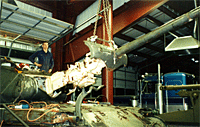
would say the most difficult part is the weight of the
components. Ideally, everything is done with a crane.
A person could get by if he had a little front-end loader;
even a small forklift would work because the components
are too heavy for one person to lift. Two people can lift
some of the components, but to hold them in position and
fasten them to the vehicle, you need something that's
stationary. I think one of the hardest restoration decisions
is not to take shortcuts. It's really easy to tell yourself,
'Well, nobody's going to see this way down under the engine
since all the wiring is enclosed in conduits. So let's
just go to the neighborhood auto parts store and buy the
plastic wiring.' However, at the Foundation we go with
the original cloth wiring with the original correct color
codes. We want to stay original and quite detailed - probably
more detailed than it would be out of the factory.” “I
would say the most difficult part is the weight of the
components. Ideally, everything is done with a crane.
A person could get by if he had a little front-end loader;
even a small forklift would work because the components
are too heavy for one person to lift. Two people can lift
some of the components, but to hold them in position and
fasten them to the vehicle, you need something that's
stationary. I think one of the hardest restoration decisions
is not to take shortcuts. It's really easy to tell yourself,
'Well, nobody's going to see this way down under the engine
since all the wiring is enclosed in conduits. So let's
just go to the neighborhood auto parts store and buy the
plastic wiring.' However, at the Foundation we go with
the original cloth wiring with the original correct color
codes. We want to stay original and quite detailed - probably
more detailed than it would be out of the factory.”
Since many collectors do not have the facilities and equipment
to house and restore larger military vehicles under cover,
smaller tanks are more popular and valuable than their larger
and heavier counterparts. Smaller tanks (under 20 tons)
can be moved with tilt-bed trailers and other commercial
construction equipment, and they can be stored and worked
on in a large garage.
For those collectors who are able to collect larger and
heavier armored vehicles, an extensive infrastructure needs
to be established before restoration work can be started.
Roy Robertson, Foundation curator, explains:
 “You
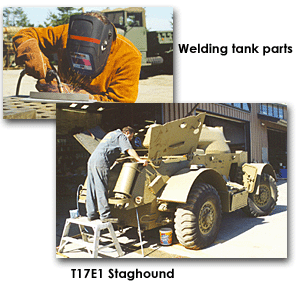
need an area where there is sufficient room to gain access
to all sides of the vehicle for workers as well as the
lifting equipment. You also need at least double or triple
the space occupied by the vehicle to store the various
components as they are removed and rebuilt. A covered
area is always best, but I've seen first-class restoration
work done under tarps and temporary roofs. Electricity
for lights, welders, and air compressors are a must. Heating,
cooling fans and ventilation requirements will depend
on the local weather, but the work is more pleasant when
these factors are taken into account. High quality tools
and machinery are a must; skimping on the quality of the
tools or overstressing their capacity will result in frustration,
skinned knuckles, or possibly more serious injury to those
involved in the work. Last, it helps to have the appropriate
manuals before starting your restoration project.” “You
need an area where there is sufficient room to gain access
to all sides of the vehicle for workers as well as the
lifting equipment. You also need at least double or triple
the space occupied by the vehicle to store the various
components as they are removed and rebuilt. A covered
area is always best, but I've seen first-class restoration
work done under tarps and temporary roofs. Electricity
for lights, welders, and air compressors are a must. Heating,
cooling fans and ventilation requirements will depend
on the local weather, but the work is more pleasant when
these factors are taken into account. High quality tools
and machinery are a must; skimping on the quality of the
tools or overstressing their capacity will result in frustration,
skinned knuckles, or possibly more serious injury to those
involved in the work. Last, it helps to have the appropriate
manuals before starting your restoration project.”
Most of the historical armored military vehicles arrive
at the Foundation in poor shape. Restoration work is quite
daunting and is not to be undertaken by those without a
clear understanding of the time and effort involved. At
the Foundation shops, a restoration project starts with
disassembly of the entire vehicle with every step documented
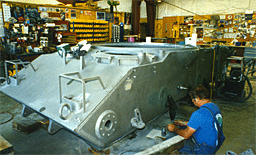
by annotated photographs. Sandblasting removes old layers
of paint and rust. Filling damaged areas of the parts by
brazing and welding follows sandblasting. The parts are
then cleaned and repainted. If required, new parts are built
to original specifications and the vehicle is reassembled.
The Foundation shops are well equipped with both ordinary
and specialized equipment. Tools include a large drill press,
powered grinders, a band saw, variable-speed drills, 1/2
and 3/4-inch impact wrenches and sockets as well as portable
hydraulic rams. A gas torch is frequently used to loosen
larger rusted nuts and bolts. A hydraulic press is required
to assemble bearings and seals. A variety of electric and
automotive test equipment is used to tune the engines and
troubleshoot complex wiring.
When parts are missing or damaged beyond recognition, we
take a threefold approach. First, we search through our
large collection of books, photos and technical manuals
for illustrations showing the missing part. Second, we visit
museums to measure and photograph similar items. To recreate
missing metal parts we employ an engine lathe, a milling
machine, a hydraulic ironworker, a band saw, and a arbor
press and sheet metal equipment. Jacques Littlefield, founder
and President of the Foundation and the man with many years
of experience, sums up his attitude towards restoring large
military vehicles:
 “Patience
and the realization that the process takes more time than
for other typical hobbies will help put things into perspective
and add to a feeling of satisfaction at the end of the
job. Placing the rear end of a half-track next to the
rear end of a Ford Mustang will give you some idea of
what the scale of things is. If that fails to impress
you, take a look at the front axle of a 24-ton M26 Dragon
Wagon or the steering unit of a 32-ton Sherman tank.” “Patience
and the realization that the process takes more time than
for other typical hobbies will help put things into perspective
and add to a feeling of satisfaction at the end of the
job. Placing the rear end of a half-track next to the
rear end of a Ford Mustang will give you some idea of
what the scale of things is. If that fails to impress
you, take a look at the front axle of a 24-ton M26 Dragon
Wagon or the steering unit of a 32-ton Sherman tank.”
On arrival at the Foundation, military vehicles are categorized
as hulk, operational,
or factory new.
A hulk is a vehicle
that is structurally intact but is missing tires, tracks,
an engine and other major pieces. A typical hulk has been
in a junkyard for more than 40 years. There are over 30
vehicles within the Foundation collection that are classified
as hulk. Even
if usable parts are available, these vehicles will require
major effort and expense to raise their rating to the operational
category.
Most vehicles in the Foundation's collection are categorized
operational.
These examples are complete and look like they did at the
end of their service lives. Operational
vehicles are often fitted with demilitarized armament but
radios, optics, markings and other historically significant
fittings will be missing.
Vehicles categorized as factory
new have been totally dissembled and all
parts restored cleaned, plated, and painted per the original
specification. The engine, transmission, rear end, steering
unit, and tires (or tracks) will have been rebuilt to like-new
standards and will be fully operational. Fire extinguishers,
ventilation, storage boxes, decals weapon mounts, seats,
stabilizers and other details will all be present and completely
functional. Vehicles missing minor fittings or accessories
that are impossible to recreate legitimately fall in the
factory new category;
especially during wartime, most brand new vehicles were
shipped incomplete. Factory
new vehicles are ready for battle with the
addition of live ammunition, rations, fuel, and a crew.
The decision to completely restore a vehicle is based on
historical significance and rarity. Ten vehicles belonging
to the Foundation collection have been restored to factory
new condition. These examples are considered museum pieces
and are rarely driven.
Current Foundation Projects
Two more vehicles are nearing completion in the Foundation
shops: a Soviet-built 2S1 “Gvozdika”
122mm self-propelled howitzer, which first entered service
in the early 1970s, and a World War II German
Army SdKfz 222 “Panzerspahwagen” (wheeled
armored scout car).
|